Introduction
Plastic products are so embedded in our daily life that most of us rarely pause to consider what they are made of, beyond a quick look at the recycling code, until something goes wrong. Recent investigations by Consumer NZ found that some children’s toys marketed on popular e-commerce platforms contained hazardous substances at levels above recommended limits, indicating a need for continued evaluation of product safety.1 At the same time, the constant scourge of litter on road sides plus high-profile environmental events, such as the plastic bead pollution in Hauraki Gulf, highlighted how easily plastic materials can leak into the environment right across the value-chain.2 Public confidence has been further shaken by safety recalls involving products like kinetic sand, reminding us that even seemingly harmless items can lead to widespread exposure when their chemical composition is poorly understood. These examples and incidents echo the findings of a 2022 Parliamentary Commissioner for the Environment report, Knowing what’s out there, which emphasised our limited visibility over the hazardous substances present in manufactured articles, including plastics.3 This poses a simple but pressing question: what chemicals are present in plastic materials and what risks do they pose to human and environmental health?
Polymer resins
Plastics have become indispensable to modern society, valued for their versatility, durability, and low manufacturing cost. Global production of fossil-based plastics exceeded 430 million tonnes in 2024, with about 90% of production consisting of virgin fossil-based plastic.4 Four polymers dominate this production - polyethylene, polypropylene, polyvinyl chloride, and polyethylene terephthalate - which make up around two-thirds of global production. Their applications span everything from food and medical packaging to building materials and consumer goods, shaping nearly every aspect of modern life.
Plastic additives
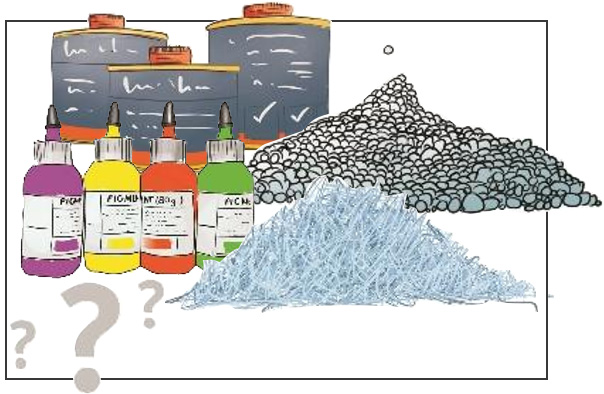
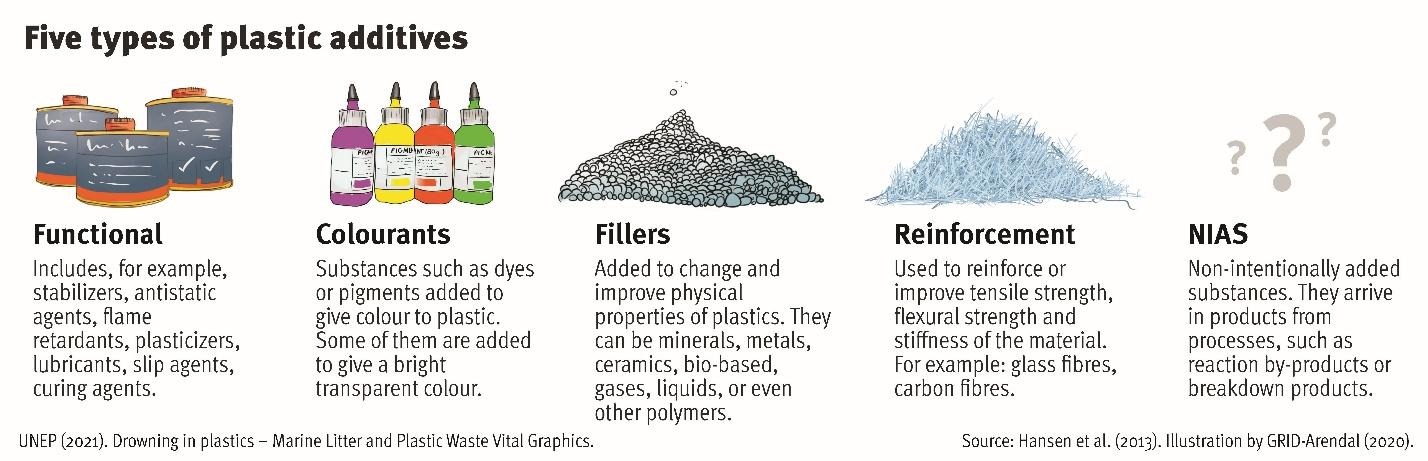
Yet plastics are far more chemically complex than their polymer name may suggest. In addition to the base resin, plastic materials contain a wide range of organic and inorganic substances added during manufacturing. Plastic additives are incorporated to impart specific functional properties to the final material, such as flexibility, colour, stability, or fire resistance. Other intentionally added substances may include residual monomers, oligomers, or catalysts remaining from the polymerisation process. Broadly, additives can be categorised as functional additives, colourants, fillers, and reinforcements (Fig. 1). They are highly diverse, covering a wide range of chemical classes. Some, such as certain phthalates or benzotriazoles, are known to exhibit hazardous properties, such as carcinogenicity, mutagenicity, and reproductive toxicity, endocrine disruption, or persistence and bioaccumulation.5 Two plastic additives, UV-328 (a UV absorber) and Dechlorane Plus (a chlorinated flame retardant), were recently classified under the Stockholm Convention as persistent organic pollutants (long-lasting, widely transported, bioaccumulative, and toxic chemicals).6 The concentration at which additives are used varies widely depending on their function; for example, flexible PVC products may contain up to 70% (w/w) plasticiser.7 Importantly, most additives are not covalently bound to the polymer matrix, meaning they can migrate from the material into surrounding environments over time.
Non-intentionally added substances
Beyond additives, plastics also contain substances never deliberately introduced. These non-intentionally added substances (NIAS) include reaction by-products formed during polymer synthesis, degradation products of polymers or additives, and contaminants introduced during manufacturing or recycling.8 Non-intentionally added substances are often unknown, poorly characterised, and highly variable, making them a major challenge for risk assessment and compliance. Their presence becomes even more complex in recycled materials, where multiple life cycles introduce and accumulate additional transformation products and contaminants. Understanding non-intentionally added substances is critical for consumer safety, especially when in contact with food and in medical applications, and for evaluating environmental risks of plastic pollution.
Recycling and chemical complexity
Plastic recycling is widely promoted to reduce waste and pollution, yet it introduces new chemical complexity. Waste stream separation is rarely perfect, and contamination of the recovered plastic is common, leading to recycled resins with inferior quality and restricted end-use applications.9-11 Contamination can originate externally (such as from food residues on food packaging) or internally (such as from additive transformation products).12 Recent evidence illustrates the breadth of this contamination. For example, a Canadian study detected more than 220 organic chemicals in recycled plastic pellets and flakes, including common additives such as organophosphate esters, brominated and chlorinated flame retardants, phthalates, and benzophenones. Importantly, the study also identified non-additive compounds such as the insect repellent diethyltoluamide (DEET), demonstrating how substances encountered during the use of plastics can be carried into recycled feedstocks.13 These unknowns limit recyclate use in sensitive applications, such as food packaging, where strict migration limits apply.14 Even aesthetics may be compromised, with colourant residues producing unpredictable appearance in recycled plastics, forcing manufacturers to mask defects with dark pigments.15
Risk to consumers and environment
Concerns about plastic safety are not new. Hazards associated with plastic additives in contact with food and in medical applications were being recognised as early as the 1950s.16 Today, these concerns extend to a wide range of consumer products, from packaging and toys to medical devices, where migration of additives and non-intentionally added substances can lead to chronic low-level exposure. Environmental risks emerged later. Initially, plastic pollution was regarded as an aesthetic issue.17 That perception changed dramatically in 2004 when Thompson and coworkers coined the term “microplastics” for plastic particles smaller than 5 mm, evoking the beginning of extensive research efforts to understand the extent and environmental impact of plastic pollution and microplastics.18 Subsequently, microplastics have been found in every sphere of the planet: atmosphere,19 hydrosphere,20 lithosphere,21 and biosphere.22
Well before microplastics became an international research focus, similar observations were being recorded in Aotearoa New Zealand. In one of the earliest documented studies of microplastic pollution, University of Auckland researcher Murray Gregory surveyed more than 300 New Zealand beaches between 1972 and 1976. He reported widespread accumulation of plastic resin pellets along many coastlines.23 Although initially considered an aesthetic nuisance rather than a hazard to wildlife, this work foreshadowed the global concern that would emerge decades later as microplastics were recognised as persistent pollutants.
While physical impacts of plastic materials are widely recognised and documented – the suffocation warning on plastic bags or striking images of wildlife entangled in plastic debris - chemical effects are more subtle and harder to detect. These arise from the substances associated with plastic pollution, such as additives and non-intentionally added substances. Plastic leachates, the sum of all substances released from a plastic, have been shown to elicit toxicity to a range of test organisms, including bacteria, algae, arthropods, echinoderms, and vertebrates.24-27
Plastic packaging and food-contact materials present a direct pathway for human exposure to additives and non-intentionally added substances. Migration of these compounds into food has been documented under typical storage conditions and can be accelerated during heating or cooking. Consumer safety is managed under regulatory frameworks that specify a positive list of authorised starting materials, monomers, polymers, and additives – such as Commission Regulation (EU) No 10/2011, Annex 1 - along with limits on both overall and specific migration into food. Tight regulation is also applied in the medical field for packaging of pharmaceutical products or plastics used in medical devices. However, non-intentionally added substances often fall outside these frameworks, creating uncertainty for risk assessment. This challenge is amplified by the increasing use of recycled plastics in packaging, where contamination and unknown compounds can compromise compliance and consumer safety.28 Outside food and medical contexts, such as toys, clothing, household goods, and construction products, regulatory oversight of plastic additives is far more limited. In New Zealand, regulation relies largely on exclusions and restrictions rather than positive inclusion lists, leaving greater scope for unknown or unassessed additives to enter the market.3 These observations highlight the complexity of chemicals in plastics and the need for analytical approaches that go beyond traditional targeted methods.
Analysis of plastic additives
One of the key challenges in understanding the risks associated with plastics is the analysis of additives and non-intentionally added substances. This complexity reflects both the broad chemical diversity of these compounds and their sheer number - more than 13,000 substances have been associated with plastics, either intentionally used during production or detected as non-intentionally added substances.29 Analytical efforts are further complicated by limited disclosure from material suppliers and brand owners.
Targeted analysis, using techniques such as HPLC and GC-MS, is well suited for quality control and regulatory compliance, particularly where specific migration limits apply. However, these methods focus on known additives and offer limited insight into the full range of non-intentionally added substances present in a material. As risk assessment increasingly requires knowledge of both expected and unexpected chemical constituents, traditional targeted approaches are no longer sufficient on their own.
Non-target screening using high-resolution mass spectrometry has emerged as a powerful tool for identifying unknown or unexpected compounds in plastics. This approach is particularly valuable given the vast number of substances linked to plastic materials. Use of both LC and GC high-resolution mass spectrometry can provide excellent coverage across volatile, semi-volatile and non-volatile compounds. Non-target workflows are now being applied to food and pharmaceutical packaging,30 environmental matrices,31 and, more recently, plastic pollution research.32 These advances provide a more comprehensive picture of the chemical landscape associated with plastic and help address key uncertainties in exposure and risk.
However, the power of high-resolution mass spectrometry also brings challenges. Datasets can contain thousands of detected features, of which only a small fraction can be annotated with high confidence. Databases of compounds and spectral libraries remain limited, and the transformation pathways of polymers and additives are not yet fully understood. More advanced workflows are therefore required to fully exploit the potential of high-resolution mass spectrometry, incorporating in-silico fragmentation, retention time prediction, and improved data processing strategies. In-silico fragmentation tools predict fragmentation patterns, allowing comparison of theoretical spectra with experimental MS/MS data and thereby compensating for gaps in spectral libraries, narrowing structural possibilities, and assisting in the ranking of candidate identifications. Retention time indices offer a valuable orthogonal confirmation step through the use of retention time markers and predictive models. To make the most of high-resolution mass spectroscopy datasets, new processing pipelines are needed that integrate feature extraction, alignment, filtering, and library matching with in-silico fragmentation and retention time prediction to improve annotation confidence.
Future outlook
Plastics will remain indispensable to modern society for the foreseeable future, underpinning essential sectors such as food packaging, healthcare, construction, and technology. The challenge ahead is not to eliminate plastics, but to manage their use more safely. As plastic products circulate through multiple life cycles - whether through direct reuse such as a refillable drink bottle, or through incorporation of recyclate into new products - their chemical profile becomes increasingly complex. This raises the possibility that unknown additives, degradation products, or contaminants may be carried forward into new uses and exposure pathways. Assessing the risks of these complex mixtures, including potential synergistic or cumulative effects from multiple chemical exposures, will require analytical approaches that extend well beyond traditional targeted methods. High-resolution mass spectrometry is well positioned to meet this need, but widespread adoption will depend on continued improvements in data processing, interpretation, and workflow standardisation. Broader use of non-target screening in both regulatory and industrial contexts will be essential to support safer product design, enable confidence in recycled materials, and reduce the environmental footprint of plastics. In this space, advances in analytical chemistry have a critical role to play in shaping a more sustainable and transparent plastics future.
Acknowledgements
Jamie Bridson would like to thank Grant Northcott (Northcott Research Consultants Ltd), Dawn Smith, Robert Abbel (Bioeconomy Science Institute), and Sally Gaw (University of Canterbury) for their supervision and guidance during the PhD research that formed the basis of this work.
References
- Consumer NZ. Testing reveals unsafe kids’ toys, USB chargers and necklaces sold through Temu and Shein. https://www.consumer.org.nz/articles/testing-reveals-unsafe-kids-toys-usb-chargers-and-necklaces-sold-through-temu-and-shein?utm_source=chatgpt.com (accessed 18/12/2025).
- The New Zealand Herald. Plastic beads pollute Hauraki Gulf beaches, industry criticised for inaction. https://www.nzherald.co.nz/nz/plastic-beads-pollute-hauraki-gulf-beaches-industry-criticised-for-inaction/F5JH7YLHLZBOTHRO64VT5CV4QE/ (accessed 18/12/2025).
- PCE. Knowing what's out there: Regulating the environmental fate of chemicals; Parliamentary Commissioner for the Environment: Wellington (NZ), 2022.
- Plastics Europe. Plastics: The Fast Facts 2025, Plastics Europe AISBL: Brussels, Belgium, 2025.
- Groh, K. J.; Backhaus, T.; Carney-Almroth, B.; Geueke, B.; Inostroza, P. A.; Lennquist, A.; Leslie, H. A.; Maffini, M.; Slunge, D.; Trasande, L.; Warhurst, A. M.; Muncke, J. Science of The Total Environment 2019, 651, 3253–3268.
- Environmental Protection Authority. Restricting three new Stockholm Convention chemicals. https://www.epa.govt.nz/public-consultations/completed/proposal-to-restrict-three-new-stockholm-convention-chemicals/ (accessed 28/01/2026).
- Hahladakis, J. N.; Velis, C. A.; Weber, R.; Iacovidou, E.; Purnell, P. Journal of Hazardous Materials 2018, 344, 179–199.
- Nerin, C.; Alfaro, P.; Aznar, M.; Domeno, C. Analytica Chimica Acta 2013, 775, 14–24.
- Chappell, B.; Pramanik, A.; Basak, A. K.; Sarker, P. K.; Prakash, C.; Debnath, S.; Shankar, S. Cleaner Materials 2022, 6, 100158.
- Chea, J. D.; Yenkie, K. M.; Stanzione III, J. F.; Ruiz-Mercado, G. J. Journal of Hazardous Materials 2023, 441, 129902.
- Wagner, S.; Schlummer, M. Resources, Conservation and Recycling 2020, 158, 104800.
- Horodytska, O.; Cabanes, A.; Fullana, A. Chemosphere 2020, 251, 126373.
- Chibwe, L.; De Silva, A. O.; Spencer, C.; Teixera, C. F.; Williamson, M.; Wang, X.; Muir, D. C. G. Environmental Science and Technology 2023, 57 (8), 3380–3390.
- De Tandt, E.; Demuytere, C.; Van Asbroeck, E.; Moerman, H.; Mys, N.; Vyncke, G.; Delva, L.; Vermeulen, A.; Ragaert, P.; De Meester, S.; Ragaert, K. Waste Management 2021, 119, 315–329.
- Ferreira, A. M.; Sucena, I.; Otero, V.; Angelin, E. M.; Melo, M. J.; Coutinho, J. A. P. Molecules 2021, 27 (1), 98.
- Harris, D. K. British Journal of Industrial Medicine 1959, 16 (3), 221–229.
- US National Research Council. Assessing potential ocean pollutants. National Academy of Sciences: Washington, 1975.
- Thompson, R. C.; Olson, Y.; Mitchell, R. P.; Davis, A.; Rowland, S. J.; John, A. W. G.; McGonigle, D.; Russell, A. E. Science 2004, 304 (5672), 838.
- Xu, A.; Shi, M.; Xing, X.; Su, Y.; Li, X.; Liu, W.; Mao, Y.; Hu, T.; Qi, S. Environmental Pollution 2022, 303, 119173.
- Dusaucy, J.; Gateuille, D.; Perrette, Y.; Naffrechoux, E. Environmental Pollution 2021, 284, 117075.
- Li, J.; Song, Y.; Cai, Y. Environmental Pollution 2020, 257, 113570.
- Azizi, N.; Khoshnamvand, N.; Nasseri, S. Regional Studies in Marine Science 2021, 47, 101955.
- Gregory, M. R. New Zealand Journal of Marine and Freshwater Research 1978, 12 (4), 399–414.
- Capolupo, M.; Sorensen, L.; Jayasena, K. D. R.; Booth, A. M.; Fabbri, E. Water Research 2020, 169, 115270.
- Ke, A. Y.; Chen, J.; Zhu, J.; Wang, Y. H.; Hu, Y.; Fan, Z. L.; Chen, M.; Peng, P.; Jiang, S. W.; Xu, X. R.; Li, H. X. Marine Pollution Bulletin 2019, 142, 54–57.
- Oliviero, M.; Tato, T.; Schiavo, S.; Fernandez, V.; Manzo, S.; Beiras, R. Environmental Pollution 2019, 247, 706–715.
- Tetu, S. G.; Sarker, I.; Schrameyer, V.; Pickford, R.; Elbourne, L. D. H.; Moore, L. R.; Paulsen, I. T. Communications Biology 2019, 2, 184.
- Office of the Prime Minister's Chief Science Advisor. Rethinking Plastics in Aotearoa New Zealand, Office of the Prime Minister's Chief Science Advisor: New Zealand, 2019.
- UNEP. Chemicals in plastics: A technical report; United Nations Environment Programme and Secretariat of the Basel, Rotterdam and Stockholm Conventions: Geneva (CH), 2023.
- Martínez-Bueno, M. J.; Gómez Ramos, M. J.; Bauer, A.; Fernández-Alba, A. R. TrAC Trends in Analytical Chemistry 2019, 110, 191–203.
- Paszkiewicz, M.; Godlewska, K.; Lis, H.; Caban, M.; Białk-Bielińska, A.; Stepnowski, P. TrAC Trends in Analytical Chemistry 2022, 154, 116671.
- Bridson, J. H.; Masterton, H.; Knight, B.; Paris, C. F.; Abbel, R.; Northcott, G. L.; Gaw, S. Science of The Total Environment 2024, 949, 175251