Sustainable protein systems and the need for improved interfacial functionality
The increasing global demand for sustainable food systems has accelerated the development of alternative protein sources with reduced environmental impact compared with conventional animal-derived proteins used to stabilise interfaces in food emulsions, thereby helping to maintain emulsion structure and stability. Plant proteins, including soy and pea proteins, have attracted considerable interest due to their lower resource requirements and potential contribution to future protein production systems. However, successful incorporation of plant proteins into functional foods requires not only environmental benefits but also the ability to provide functions such as stabilising emulsions and maintaining food structure.1,2
Compared with dairy proteins, many plant protein ingredients exhibit limitations associated with molecular complexity, aggregation behaviour, solubility and interfacial functionality. Commercial plant protein isolates are heterogeneous systems containing different protein fractions and aggregated structures. Their functional properties are strongly influenced by extraction and processing history. These factors affect protein accessibility, adsorption behaviour and the ability to form functional interfacial films.2,3
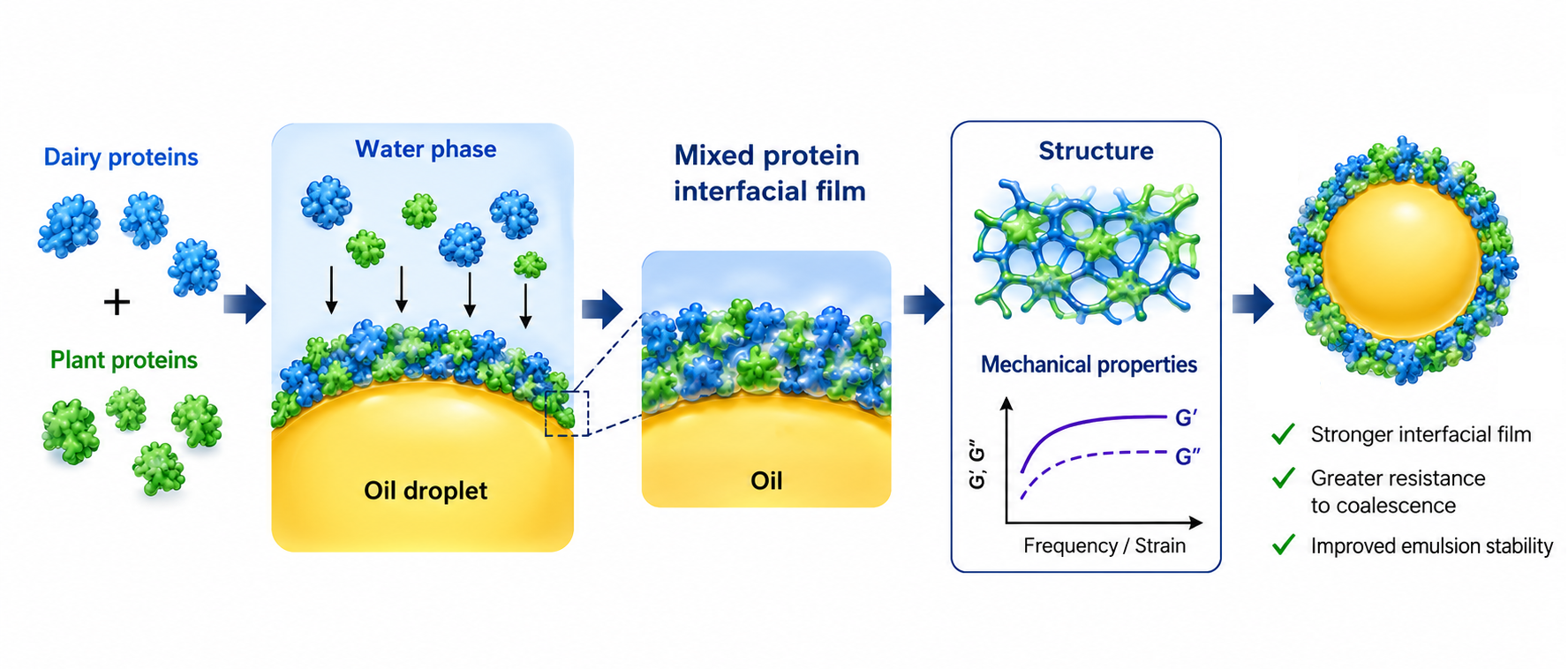
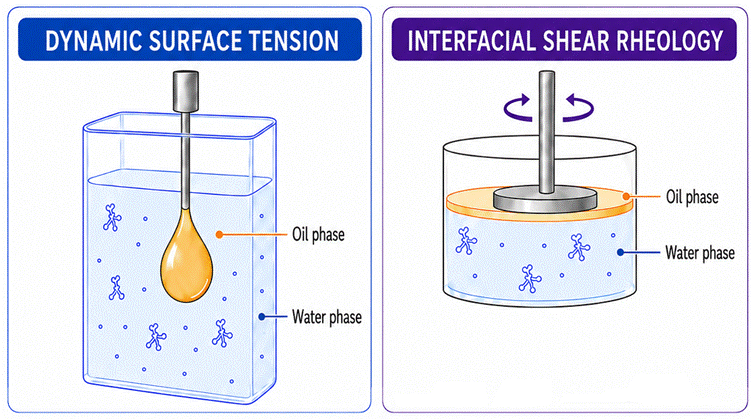
This challenge is particularly important in emulsion-based food systems, where proteins must adsorb at oil–water interfaces and form cohesive interfacial layers capable of stabilising dispersed droplets (Fig. 1). Protein adsorption reduces interfacial tension, while the structural organisation and mechanical properties of the resulting interfacial film determine resistance against destabilisation. Therefore, improving plant protein functionality requires understanding not only adsorption kinetics but also the development of mechanically robust interfacial films.1,3,4
Combining plant proteins with dairy proteins represents a promising strategy to enhance functional performance while retaining the environmental advantages of plant-derived ingredients. Understanding how different proteins interact at interfaces is therefore essential for designing improved protein-based food systems.1,4,5
Protein-stabilised interfaces and interfacial film formation
Protein-stabilised interfaces are dynamic molecular assemblies whose structure and mechanical properties develop through adsorption, conformational rearrangement and intermolecular association processes occurring after proteins reach the oil–water interface. Protein-covered interfaces form evolving two-dimensional structures in which molecular organisation determines the functional properties of the resulting interfacial film.2,4,6
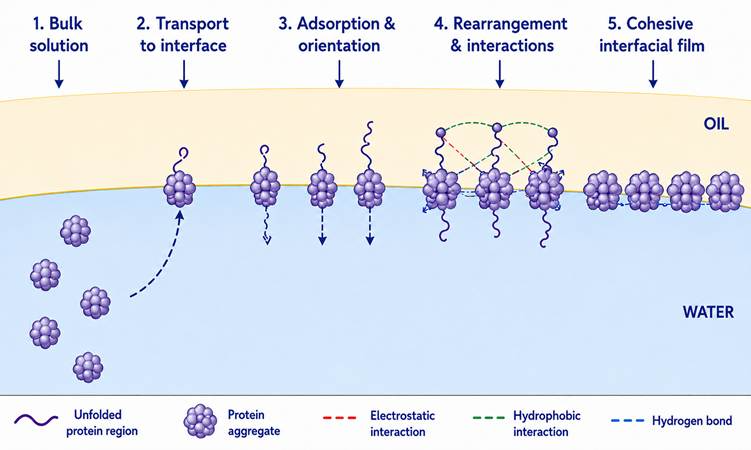
The formation of protein-stabilised interfaces begins with transport of proteins from the bulk phase towards the interface, initially governed by diffusion.6 Following arrival, proteins adsorb and reduce interfacial free energy, resulting in increased surface pressure as molecules occupy available interfacial area.4,6 Surface pressure development depends not only on the amount of adsorbed protein but also on adsorption kinetics, molecular rearrangement and interactions within the interfacial layer.6,7
After adsorption, proteins undergo structural adaptation driven by the physicochemical environment of the interface.7,8 Depending on their molecular characteristics, proteins may partially unfold, reorient or reorganise within the interfacial plane.8 Consequently, interfacial film development is governed by both adsorption behaviour and intrinsic protein properties, including molecular flexibility, structural compactness, surface hydrophobicity, charge distribution and conformational stability.3,6
The formation of cohesive interfacial films is further influenced by intermolecular interactions between adsorbed proteins.9 Hydrophobic interactions, electrostatic interactions and hydrogen bonding contribute to molecular association and network development, while disulfide interactions and thiol–disulfide exchange reactions may strengthen films formed by proteins containing reactive thiol groups, such as β-lactoglobulin.8,9 The balance between these interactions determines interfacial network formation, structural organisation and viscoelastic behaviour.3,9
Consequently, proteins with different molecular structures generate distinct interfacial films and mechanical responses.3,4,10 Surface pressure measurements provide valuable information regarding adsorption kinetics and film development; however, they cannot fully describe the mechanical functionality of the interface.6 Interfacial rheology is therefore required to determine film strength, viscoelasticity and deformation behaviour, providing insight into the relationship between molecular organisation, interfacial structure and mechanical performance (Fig. 2).9,10
Single-protein interfacial films: dairy and plant proteins
Dairy and plant protein ingredients are complex systems containing multiple protein fractions with different structural characteristics. Dairy proteins, including whey proteins and caseins, are widely studied due to their strong interfacial activity and ability to form functional films. Plant proteins mainly consist of globular storage proteins, such as soy 7S and 11S globulins and pea legumin- and vicilin-type proteins.1-3
Dairy proteins: whey proteins and caseins
Whey protein isolate (WPI) is one of the most extensively studied dairy protein ingredients for interfacial stabilisation due to its strong emulsifying capacity and ability to form cohesive protein films. Commercial WPI is mainly composed of β-lactoglobulin (BLG), together with smaller amounts of other whey proteins. Although several components contribute to adsorption, BLG is considered the dominant contributor to WPI interfacial behaviour because of its abundance, globular structure and ability to undergo adsorption-induced rearrangement.4,8
Dynamic interfacial tension studies show that WPI exhibits slower adsorption compared with more flexible proteins, reflecting the requirement for molecular rearrangement after adsorption.4 However, prolonged adsorption results in cohesive interfacial layers with high resistance to deformation.4 Interfacial rheological studies demonstrate the development of elastic films associated with interconnected protein networks.1,4 BLG is therefore widely used as a model protein for investigating adsorption-induced conformational changes and interfacial film formation, where partial unfolding and intermolecular association contribute to cohesive viscoelastic films.7,8
In contrast, sodium caseinate (SC) represents a flexible and disordered dairy protein system. Its lack of rigid tertiary structure enables rapid adsorption and surface coverage without extensive conformational rearrangement. However, Langmuir compression and interfacial rheology measurements have shown that SC films often exhibit lower elastic responses compared with globular protein films, reflecting differences in interfacial organisation and film structure.4
Plant proteins: pea protein isolate (PPI)
Plant protein isolates are mainly composed of globular storage proteins, including soy 7S β-conglycinin and 11S glycinin fractions and pea legumin- and vicilin-type globulins. Among plant proteins, pea protein isolate (PPI) has emerged as an important sustainable alternative to dairy proteins.2
PPI can exhibit rapid initial adsorption at oil–water interfaces; however, rapid adsorption does not necessarily result in mechanically optimal films because the adsorbed layer contains protein populations with different sizes, structures and rearrangement abilities. Structural characterisation and interfacial rheology demonstrate that PPI forms heterogeneous viscoelastic films containing interacting protein assemblies rather than uniform molecular layers. The mechanical response of these films depends strongly on aggregate morphology and protein organisation.3,11
Compared with BLG, PPI functionality is more strongly associated with the packing and interaction of adsorbed protein assemblies rather than extensive adsorption-induced unfolding. Therefore, PPI represents a structurally complex plant protein system where adsorption kinetics, aggregation behaviour and interfacial mechanics are closely interconnected, providing the basis for understanding mixed BLG–PPI interfacial films.3,5,11
Formation and evolution of mixed interfacial protein films
Mixed dairy–plant protein interfaces are dynamic systems in which film composition and structure are determined not only by individual protein properties but also by interactions occurring during adsorption and subsequent film development.12 When multiple proteins are present, interfacial organisation is governed by competition, preferential adsorption and co-adsorption processes, meaning that interfacial composition may differ from bulk composition. 4 Proteins with greater interfacial affinity or faster adsorption kinetics may become enriched at the interface, influencing the structure and functionality of the resulting film.4
During simultaneous adsorption, the organisation of mixed protein films depends on the balance between competing adsorption behaviour and protein–protein interactions.1,4 Studies of dairy–plant protein systems, including WPI–PPI, WPI–SPI (soy protein isolate) and SC–PPI blends, demonstrate that mixed films may develop through preferential adsorption or co-adsorption depending on the protein combination and experimental conditions.1,4,13 Consequently, mixed interface behaviour cannot be predicted solely from the initial bulk protein ratio.1,4,12,13
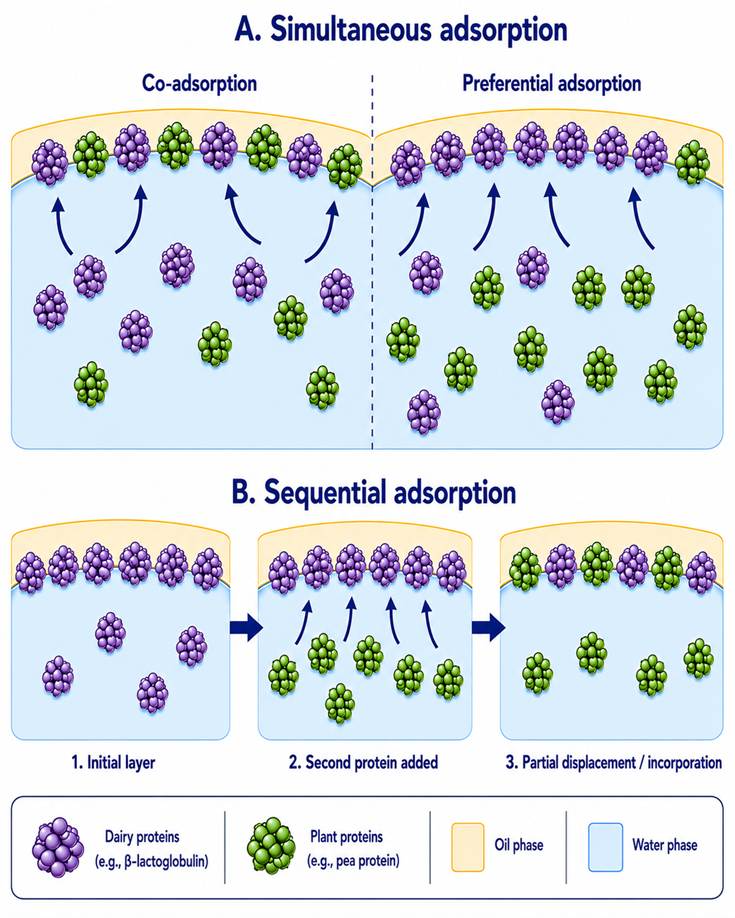
Sequential adsorption introduces additional complexity because incoming proteins interact with an already established interfacial layer (Fig. 3). The extent of protein displacement and incorporation depends on the composition, structure and accessibility of the pre-existing film. Therefore, identical protein mixtures may generate different interfacial structures depending on adsorption history, demonstrating that mixed protein film formation is a dynamic process rather than a simple equilibrium phenomenon.12
Following initial adsorption, mixed protein films continue to evolve through molecular rearrangement, structural reorganisation and intermolecular association. Structural characterisation using Langmuir trough measurements, ellipsometry and atomic force microscopy has demonstrated that dairy–plant protein blends form heterogeneous interfacial structures rather than uniform molecular layers. These differences arise from variations in protein structure, flexibility and interfacial affinity, which influence the organisation of the adsorbed layer during film maturation.4
The evolution of mixed interfacial films is also reflected in their mechanical development. While adsorption measurements provide information on protein accumulation at the interface, interfacial rheology reveals how molecular organisation translates into mechanical properties. Therefore, combining adsorption measurements, structural characterisation and rheological analysis provides a more complete understanding of the relationship between protein adsorption, film evolution and interfacial functionality.5,11
The final properties of mixed dairy–plant protein interfaces depend on the balance between these formation and evolution processes. Consequently, protein blending may result in either synergistic or antagonistic effects depending on the protein combination, formulation and experimental conditions. Ho et al.1 demonstrated that selected WPI–SPI and WPI–PPI blends exhibited improved interfacial and emulsion performance, whereas SC–SPI and SC–PPI blends showed contrasting behaviour under the same experimental framework. Previous studies have also reported improved stability for SC–SPI and SC–PPI systems under different formulations, highlighting that synergistic interactions are context-dependent rather than intrinsic properties of a specific protein pair.14,15
Mechanical behaviour of protein interfacial films
The structural organisation of mixed protein films described in the previous sections ultimately determines their mechanical behaviour. Although dynamic interfacial tension provides valuable information regarding protein transport, adsorption kinetics and interfacial film formation, it does not directly characterise the mechanical properties of the adsorbed layer. Importantly, adsorption equilibrium does not necessarily correspond to mechanical equilibrium, as interfacial films may continue to develop after adsorption through molecular rearrangement, intermolecular association and progressive network formation within the interfacial layer.4,7
To characterise the mechanical properties of protein interfacial films, interfacial rheological techniques have become increasingly important. Among these, dilatational interfacial rheology has been widely applied in protein-stabilised systems and provides information on the viscoelastic behaviour of interfaces subjected to changes in area. However, because dilatational deformation probes the response of the film during expansion and compression, it provides only partial information about the organisation and mechanical strength of the interfacial layer.4,16
In contrast, interfacial shear rheology probes the behaviour of the adsorbed layer under tangential deformation while maintaining an essentially constant interfacial area. This provides complementary information regarding the mechanical organisation, lateral connectivity and structural evolution of interfacial protein networks beyond adsorption measurements alone. Sagis and Fischer16 highlighted that the nonlinear rheological behaviour of complex interfaces originates from deformation-induced changes in interfacial microstructure, demonstrating the close relationship between molecular organisation and mechanical behaviour.
Although adsorption behaviour and dilatational rheological properties of mixed dairy–plant protein systems have been investigated in several studies, comparatively fewer studies have characterised their interfacial shear rheological properties. Consequently, the relationship between mixed protein film composition, molecular organisation at the interface and resulting mechanical performance remains insufficiently understood. Understanding these relationships is essential for determining how protein interactions within mixed dairy–plant interfaces contribute to the formation of mechanically robust and functional interfacial films.4,11,16
Research gap and future perspectives
Despite extensive research on protein-stabilised interfaces, the relationship between mixed protein film composition, interfacial organisation and resulting mechanical functionality is still not well understood. While previous studies have characterised adsorption behaviour, film formation and interfacial viscoelasticity in dairy–plant protein systems, these approaches have provided limited insight into how molecular organisation within mixed films determines their resistance to deformation and mechanical performance.4,6,9
Dairy–plant protein blends represent particularly complex systems because their interfacial properties cannot be predicted solely from the behaviour of individual proteins. However, the mechanisms linking protein interactions within mixed films to their macroscopic mechanical response remain unclear. In particular, limited information is available regarding how differences in mixed film organisation influence interfacial shear behaviour and the development of mechanically robust structures.1,11,12
Therefore, a more comprehensive understanding of dairy–plant protein interfaces requires establishing the relationship between adsorption processes, interfacial organisation and mechanical behaviour. Combining complementary approaches that characterise both film formation and interfacial mechanics represents an important direction for advancing the rational design of sustainable and functional protein-based food systems.
References
- Ho, K.K.H.Y.; Schroën, K.; San Martín-González, M.F.; Berton-Carabin, C.C. Food Hydrocolloids 2018, 81, 180–190.
- Hinderink, E.B.A.; Münch, K.; Sagis, L.; Schroën, K.; Berton-Carabin, C.C. Food Hydrocolloids 2019, 97, 105206.
- Grasberger, K.F.; Lund, F.W.; Simonsen, A.C.; Hammershøj, M.; Fischer, P.; Corredig, M. Journal of Colloid and Interface Science 2024, 658, 156–166.
- Hinderink, E.B.A.; Sagis, L.; Schroën, K.; Berton-Carabin, C.C. Colloids and Surfaces B: Biointerfaces 2020, 192, 111015.
- Grasberger, K.; Sunds, A.V.; Sanggaard, K.W.; Hammershøj, M.; Corredig, M. Innovative Food Science & Emerging Technologies 2022, 81, 103136.
- Beverung, C.J.; Radke, C.J.; Blanch, H.W. Biophysical Chemistry 1999, 81, 59–80.
- Graham, D.E.; Phillips, M.C. Journal of Colloid and Interface Science 1979, 70, 403–414.
- Zhai, J.; Wooster, T.J.; Hoffmann, S. V.; Lee, T.H.; Augustin, M.A.; Aguilar, M.I. Langmuir 2011, 27, 9227–9236.
- Bos, M.A.; Vliet, T. van. Advances in Colloid and Interface Science 2001, 91, 437–471.
- Yang, J.; Thielen, I.; Berton-Carabin, C.C.; Linden, E. van der; Sagis, L.M.C. Food Hydrocolloids 2020, 101, 105466.
- Kim, W.; Wang, Y.; Selomulya, C. Food Hydrocolloids 2025, 169, 111622.
- Hinderink, E.B.A.; Sagis, L.; Schroën, K.; Berton-Carabin, C.C. Journal of Colloid and Interface Science 2021, 583, 704–713.
- Zhang, X.; Zhang, S.; Xie, F.; Han, L.; Li, L.; Jiang, L.; Qi, B.; Li, Y. Journal of the Science of Food and Agriculture 2021, 101, 262–271.
- Ji, J.; Zhang, J.; Chen, J.; Wang, Y.; Dong, N.; Hu, C.; Chen, H.; Li, G.; Pan, X.; Wu, C. Food Hydrocolloids 2015, 51, 156–165.
- Yerramilli, M.; Longmore, N.; Ghosh, S. Food Hydrocolloids 2017, 64, 99–111.
- Sagis, L.M.C.; Fischer, P. Current Opinion in Colloid & Interface Science 2014, 19, 520–529.
Biography