.jpg)

Introduction
Why did you choose to study chemistry? Was it a great teacher, a positive experience with chemistry, or did chemistry just seem like the right “fit” for you? Was it down to a single experience or a series of experiences that led you to study and perhaps follow a career in chemistry?
These are questions I have often thought about as a chemistry educator because the answer would not only help better engage students who already study chemistry, it might also help to attract more students to study and appreciate chemistry. Over the years I’ve explored these questions in different ways, and while I don’t have (or believe there is) a single clear answer, I would like to share the following thoughts.
Statistically speaking
The New Zealand Association of Scientists (NZAS) 2025 survey1 included items that provided insight into why those with science qualifications had chosen to study science. Of the 997 scientists who responded to the survey, 100 identified their highest qualification as being in the chemical sciences, allowing their results to be explored separately.
The 2025 survey included asking participants to rate how important various factors were in becoming a science/technology/engineering professional using a five-point Likert scale. The results for the chemistry graduates are shown in Fig. 1.
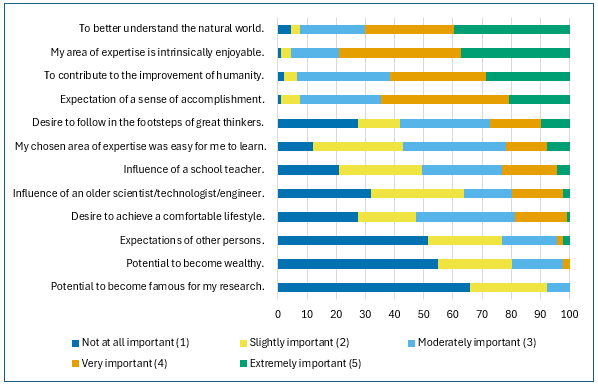
As can be seen from Fig. 1, four reasons emerge as the most significant: (1) intrigue with the search for truth and an understanding of the natural world, (2) intrinsic enjoyment in ones’ area of expertise, (3) a desire to contribute to the improvement and advancement of humanity and (4) the expectation of a sense of accomplishment. The least common reasons were to become famous or wealthy, which I doubt is surprising to readers.
Other reasons worth noting include the influence of a schoolteacher, for which over half (50.6%) of participants considered at least moderately important, and the influence of an older scientist/technologist/engineer for which over one third (36.3%) of participants considered at least moderately important.
So, what clues do these results give us regarding attracting and sustaining students’ engagement in chemistry?
For those involved in chemistry education, I would ask, does the way we teach chemistry explicitly show how chemistry helps us understand the search for truth and understand the natural world? From astrochemistry which helps us understand the composition of the universe to neurochemistry and its role in understanding human behaviour, the world is filled with incredible applications of chemistry we can draw on. Similarly, how often do we communicate how much chemistry has contributed to the betterment of humankind? From improving the quality and life expectancy of humankind through new drugs to providing the metals, glasses and plastics that make our everyday lives more comfortable, while also noting that some of the challenges created by some of these innovations (e.g. microplastic pollutants) will need a new generation of chemists to find solutions.
The expectation of a sense of accomplishment and the intrinsic joy that comes from finding an area of expertise may also suggest opportunities to optimise chemistry education. Do we provide learners with the opportunity to explore areas of chemistry that interest them through choice and project work? How well do we acknowledge student achievement and progression, and scaffold teaching so students develop intrinsic joy in studying chemistry?
The importance of schoolteachers and creating student connections with scientists, engineers and other professionals has clearly been an influence for many of us. So how do we make sure that we support the next generation of chemists? School visits, science fairs and other outreach activities where the right words at the right time could be the tipping point between a chemistry career or another path?
Popular media
Another item in the survey which I hoped would tease out some insights was asking participants to name any books, TV series or films which influenced them to become a scientist/technology professional. For the biologists David Attenborough and his work was a major factor, however for chemists the references were more dispersed. The TV series CSI was mentioned four times, Cosmos and Stephen Hawkings twice, and a variety of science fiction (Star Trek, Jurassic Park, Sherlock Holmes, Michael Crichton, and Isaac Asimov) and non-fiction (The Boy Chemist, The Renegade Cell, various science encyclopaedias) sources were mentioned but with no clear patterns of inspiration.
While these results provided few clues, it did make me wonder - has chemistry missed out by not having a popular science communicator linked to our field like biology (David Attenborough, David Bellamy), physics (Carl Sagan, Brian Cox), and medicine (Robert Winston)? Do we have any budding chemistry communicators in New Zealand?
What careers does chemistry lead to?
One possible challenge in developing and sustaining study interest in high schools may be a lack of clarity regarding the many interesting career paths it leads to. Chemistry is valuable across the health sciences and many areas of engineering, for example. I would note, however, that sometimes students are actively encouraged to avoid chemistry in favour of subjects where it is considered easier to gain an “excellence” grade if they are aiming for programmes such as medicine, a rather disturbing phenomenon.
As well as chemistry being a pathway into various other programmes, there is also limited information on career opportunities for chemistry graduates. While I have done some research on the job prospects for chemistry PhD graduates,2 there is very little information available on the roles those with undergraduate chemistry graduates occupy. This is an area where more work needs to be done.
As a start towards providing more information on where studying chemistry can lead to, last year Evie Boyd, a science communication student from the University of Otago, created a pamphlet to provide information on chemistry related careers, available at:
https://nzic.org.nz/files/NZIC_Chemistry_Careers_Pamphlet.pdf
I would encourage all members to use this where they can see an opportunity to raise the profile of careers in chemistry.
Characteristics of chemists
Does nature (genetics) or nurture (environment) affect who we are and the choices we make? This question has been widely debated, with many psychologists now agreeing that much of who we are and what we do is influenced by both nature and nurture.
From a nature perspective it is probably likely that there are natural cognitive capabilities such as pattern recognition, mathematical and spatial abilities that align well with chemistry. Personality research also indicates scientists tend to score higher than average in some traits – openness to new experiences (i.e. curiosity), sense of purpose, toughmindedness and self-direction.3,4 A personal perspective written by Mark A. Murcko provides interesting insights as to what makes a great medicinal chemist, in which he includes intellectual curiosity, passion and pragmatism as important traits.5
My personal view regarding nature versus nurture is that while nature (genetics) plays a role in who we are and our choices, our environment and experiences (nurture) have a significant role to play. That is why I believe if we can create the right experiences and information for students, they will be more likely to pursue careers related to chemistry.
Learning from engineers
Engineering is another career pathway which, historically, has had difficulty communicating to students exactly what they do and the value of their profession, so a substantial amount of research has been done to explore student engagement with engineering careers. One very interesting piece of research showed that a high percentage of engineering students (63%) had at least one family member that had a career in engineering.6 This suggests that when students know someone in a particular career it likely increases the chances that they will consider that career pathway themselves and highlights the value of NZIC members being engaged in outreach such as school visits, science fairs and mentoring activities.
Conclusions
The path to chemistry study and/or a career in chemistry has many influencing factors. Understanding and addressing these factors provides opportunities to increase interest and engagement in chemistry, for example by:
- Creating and using resources which spark students’ curiosity and desire to better understand the world around us
- Highlighting the many valuable ways chemistry has improved and advanced humankind
- Connecting with and supporting schoolteachers
- Connecting with students through school visits, university open days, science fairs and mentorship programmes
- Encouraging curiosity and toughmindedness in learning
- Scaffolding learning in science and providing choice where possible to appeal to students’ interests to keep them engaged in learning
- Providing information about the various careers that chemistry can lead to
- More research by organisations to identify the career destinations and pathways of their graduates and members.
There are currently a range of initiatives around the country that address many of these points – outreach programmes at many universities, participation in science fairs, etc. I would encourage all members to get involved where they can in promoting interest in chemistry.
Featured image: IYPT 2019 IAU, CC BY 4.0 <https://creativecommons.org/licenses/by/4.0>, via Wikimedia Commons.
References
- Edmonds, M. New Zealand Association of Scientists 2025 Survey. In preparation for publication.
- Edmonds, M. Where do they go and what do they do? Chemistry in New Zealand, 2025, https://www.cinz.nz/posts/where-do-they-go-and-what-do-they-do
- Lounsbury, J. W.; Foster, N.; Patel, H.; Carmody, P.; Gibson, L. W.; Stairs, D. R. An investigation of the personality traits of scientists versus nonscientists and their relationship with career satisfaction. R&D Management 2012, 42(1), 47-59.
- Sato, W. Scientists’ personality, values, and well-being. SpringerPlus, 2016, 5(1), 613.
- Murcko, M. A. What makes a great medicinal chemist? A personal perspective: miniperspective. Journal of Medicinal Chemistry 2018, 61(17), 7419-7424.
- Jarvie-Eggart, M. E.; Singer, A. M.; Mathews, J. Parent and family influence on first-year engineering major choice. In: 2020 ASEE Virtual Annual Conference Content Access.